
The Power of the Pause

One of the concepts we speak about often in our workshops is the power of the pause.
Whether we’re coaching someone on presenting, leading a meeting, or navigating a difficult conversation, one habit shows up time and time again. We rush. We hurry to fill every quiet moment with another sentence, another explanation, another “um,” “so,” or “you know.”
Silence makes us uncomfortable.
The irony? The pause is often where the magic happens.
A well-timed pause gives your audience a moment to absorb what you’ve said. It communicates confidence. It creates anticipation. It allows your message to land instead of getting buried beneath a stream of words.
The strongest communicators don’t fear silence. They use it intentionally.
Lately, I’ve been thinking about how that same principle applies far beyond the boardroom or the stage.
Maybe we need to become more comfortable with the pauses in our own lives.
Summer Gives Us Permission
There’s something about summer that naturally invites...
An Arm, a Leg, and Two Horses' Asses: Why Great Stories Make Presentations Stick

Have you ever noticed how some presentations stay with you long after they've ended?
I can practically guarantee it’s not because of a chart or a bullet point. And it certainly isn't because someone read twenty slides word-for-word.
What people remember are the stories. The unexpected examples. The quirky facts.
The moments that make them pause and think, "I didn't know that."
In the world of presentations, we call this sticky content—information that captures attention and remains memorable long after the meeting, keynote, or training session is over.
One of the easiest ways to create sticky content is through idioms, proverbs, and the fascinating stories behind them.
Let's look at a few examples.
It Costs an Arm and a Leg
We've all used this expression.
Whether it's concert tickets, a new vehicle, or a home renovation project, when something feels outrageously expensive, we say it costs an arm and a leg.
The phrase became popular during the twentieth century, although no...
“Over Explaining Is a Form of Begging” — Mind Blown

I recently watched an interview with Kristen Bell on Re-Thinking with Adam Grant and she said something that I haven’t been able to stop thinking about:
“Over explaining is a form of begging.”
She didn’t elaborate (so as not to beg), and I have my own interpretation to which I will over explain (GASP) in this blog post.
The truth is, I believe so many of us do this without even realizing it.
We over-explain our decisions.
Our boundaries.
Our intentions.
Our pricing.
Our “no.”
Even our needs.
We’re not dishonest or unclear people, and somewhere along the way, we learned that if we could only explain ourselves well enough, maybe we’d avoid judgment, disappointment, conflict, or misunderstanding.
Maybe people would approve.
Maybe they’d stay.
Maybe they’d finally understand where we’re coming from.
And honestly? I think most people do this from a very human place.
We crave connection.
We want clarity.
We need to feel safe and understood.
And over-explaining has a strange way of doing t...
The Leadership Gap That Quietly Destroys Culture
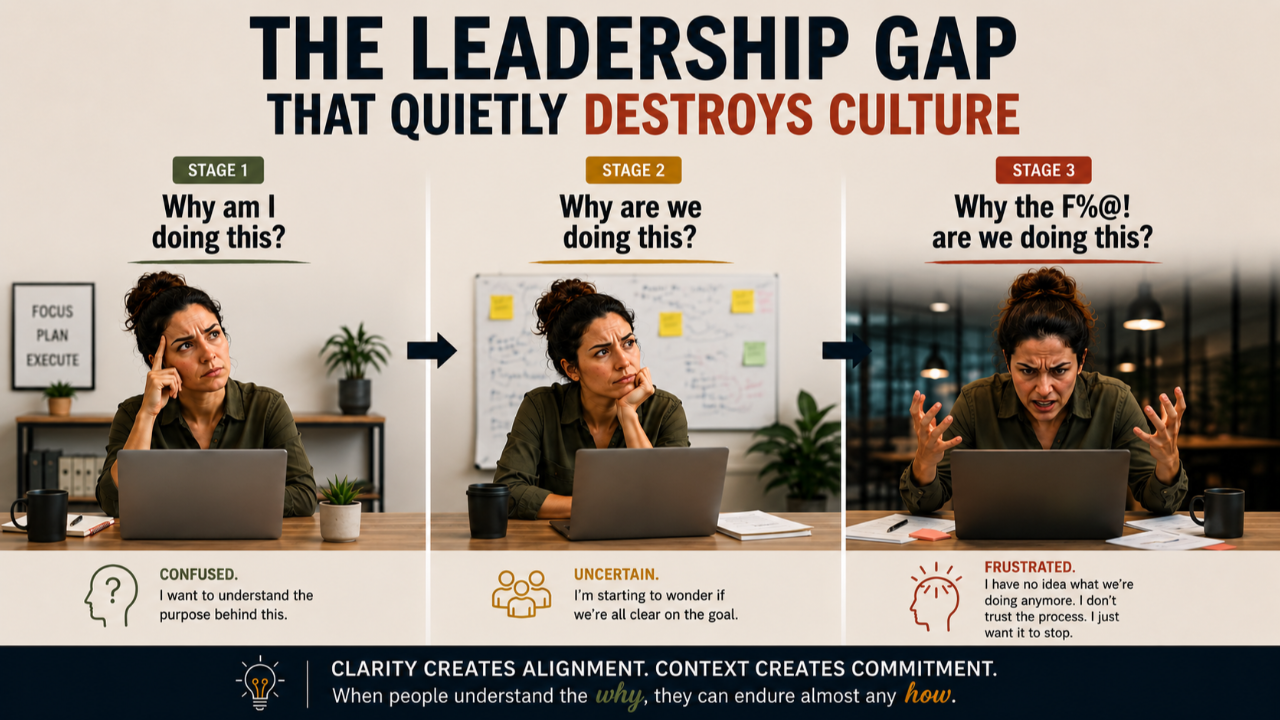
One of the biggest fractures inside organizations isn’t bad strategy.
It’s the absence of context.
Not secrecy. Not intentional withholding. Simply the gradual disconnect that happens when leadership stops explaining why decisions are being made.
A new initiative gets rolled out.
Processes change.
Priorities shift.
Teams restructure.
Targets evolve.
The leadership team understand the reasoning because (presumably) they were in the room where the conversation happened. And somewhere between the executive table and the front line, the meaning disappears.
People are told what to do without understanding why they’re doing it.
At first, most employees will still move forward. Good people usually do. They trust leadership. They assume there’s a larger strategy at play. They adapt because that’s what professionals do.
And eventually, questions can surface.
“Why are we changing this?”
“Why does this matter?”
“Why are we doing it this way?”
And if no one can answer those questions clearly, ...
Before You Chase What’s Next, Fix What’s Now

There’s something undeniably compelling about the future of a business—the vision, the scale, the possibilities. It pulls you forward. It sharpens your ambition. It gives meaning to the long hours and tough decisions.
And here’s the tension leaders don’t talk about enough:
When you become too attached to the future, you risk neglecting the very thing that determines whether you’ll ever get there—the present.
The quote says it plainly: “Don’t fall in love with the future until you get the present taken care of.”
It’s not a rejection of vision. It’s a recalibration of focus.
Because the future isn’t built in some distant, abstract space. It’s built in the conversations you’re having today. The decisions your team is making this week. The standards you’re either reinforcing, or quietly tolerating, right now.
And this is where your team becomes everything.
The Present Is a Team Sport
No founder or leader scales anything meaningful alone. Yet, many still operate as if execution is ...
How to Disagree Without Disconnecting

There’s a certain kind of conversation most of us have learned to brace for.
You see the message come in. Or you’re sitting across the table (hello Thanksgiving), and the topic takes a turn you didn’t ask for—and yet somehow expected. You can almost script the next five minutes in your head.
And if you’re honest, you’re not preparing to understand. You’re preparing to respond.
I read a piece recently about how cult experts approach conversations with people who hold deeply entrenched beliefs—especially political ones. What stood out wasn’t anything flashy or tactical. It was simple. Almost disarming.
They don’t start by trying to change the person’s mind. They start by protecting the relationship.
That idea lingers. Because if we’re honest, most of us do the opposite. We walk into disagreement trying to win clarity, prove a point, or correct what feels obviously wrong. And somewhere along the way, the connection thins out—or disappears entirely.
So, I’ve been thinking about what ...
The Trap That Keeps Business Owners Stuck in Execution

You don’t need better time management— clearer communication is the answer
If your calendar is full and your thinking feels compressed, it’s easy to assume the issue is time management. And you know what they say about assuming, right?
What you’re experiencing is the downstream effect of how your business communicates—how priorities are set, how decisions are made, and how clearly ownership is defined. When those elements lack clarity, everything flows back to you, and your capacity to think ahead disappears.
Many business owners reach a point where the days are productive, the team is moving, and yet something feels off. Decisions are happening quickly, and not always deliberately. Opportunities appear, and there’s little space to evaluate them properly.
This is what operating without foresight looks like. And more often than not, it comes down to one thing: a lack of protected thinking time—not a lack of ability.
When your time is consumed by the “urgent”, your ability to antici...
Spring Forward… Again: What Daylight Saving Time Can Teach Us About Communication
UGH. It’s Daylight Saving Time again.
The clocks jump forward. We lose an hour of sleep. Monday morning arrives faster than anyone asked for. And many of us find ourselves asking the same question we ask every single year:
Why are we still doing this? WHHHHHYYYYYYY?
Whether you love it or not, the reality is simple—every March we adjust the clock and move forward by one hour. It’s a small technical change, yet the ripple effects are immediate. Our routines feel off. Our energy dips. It takes a few days to regain our rhythm.
Interestingly enough, this annual reset offers a parallel to communication.
Communication isn’t static. Context changes. Priorities shift. People come and go. And when we continue communicating the same way we always have, things start to drift out of alignment. Messages get missed. Conversations stall. Teams operate on slightly different “clocks.”
Daylight Saving Time reminds us of something simple and powerful: sometimes a small adjustment creates a mean...
Milan 2026 Gave Us a Masterclass in Communication

We watched the world come together for the Olympic Games in Milan in 2026. Different languages. Different cultures. Different expectations. One global stage.
Yes, there were medals. Records were broken. History was made.
And what stayed with me wasn’t simply athletic performance (although that was fun to watch). It was the communication behind it — the subtle, powerful, often invisible forces that made the entire experience cohesive rather than chaotic.
If you were paying attention, Milan 2026 offered a masterclass. Not in sport. In communication.
Here’s the takeaway:
1. Clarity Wins in High-Pressure Moments
The Olympics are built on pressure. Milli-seconds matter. Decisions are scrutinized. Emotions run high.
In environments like that, vague messaging doesn’t survive.
Athletes rely on simple cues. Coaches give direct instructions. Commentators distill complex performances into clear narratives that anyone can understand. Even ceremonies carry focused themes rather than clut...
Presence Changes the Conversation—Long Before You Speak

Why intention, attention, and professionalism quietly shape credibility over time
Presence isn’t about being the most polished voice in the room. It’s about being fully there—grounded, intentional, and aware of the impact you’re creating in every interaction.
In a world that rewards speed and constant output, presence has become a quiet advantage. People can sense the difference between someone who’s responding out of habit and someone who’s showing up with purpose. The words may be similar. The experience is not.
What Presence Really Means
Presence in communication lives at the intersection of intention and attention.
- Intention is clarity around why you’re communicating. What matters in this moment? What needs to be understood, decided, or felt?
- Attention is where your focus lives while the exchange is happening. Are you listening to reply—or listening to understand? Are you present, or simply waiting for your turn?
When intention and attention align, communication becomes ...