
Zucchini, Patio Furniture and Your Message

Walk into Costco and you can buy almost anything.
You can pick up zucchini, a television, a new set of tires, a kayak and enough toilet paper to last longer than you’d probably care to admit. And somehow, it works. Costco can be many things to many people.
Your communication can’t.
One of the easiest ways to weaken a message is to try to make it relevant to everyone. We add more information. We broaden the language. We explain every angle, so no one feels left out.
And somewhere along the way, the message loses its point.
Who Are You Actually Speaking To?
“Know your audience” is standard communication advice, and it happens to be the starting point in our tool, The Power To Connect. And “Who is your audience?” is a question that’s easy to interpret too narrowly.
Knowing your audience goes well beyond demographics, job titles or where someone sits on an organizational chart. It’s important to understand what’s happening in their world right now.
What are they worried about? W...
What If Courage Doesn’t Feel Courageous?

I recently heard a line that stayed with me:
“Courage is fear that has said its prayers.”
I am drawn to the thought behind it, that courage and fear can exist at the same time. In fact, some of the most courageous things we do begin with fear.
Having the conversation we’ve been avoiding. Speaking up when it would be easier to stay quiet. Leaving something familiar. Starting something new. Admitting we don’t know. Making a decision without having every answer or knowing the outcome in advance.
As an entrepreneur, I know this feeling well. When you’re building a business, uncertainty comes with the territory. You make decisions with incomplete information. You put ideas into the world without knowing exactly how they’ll be received. You carry responsibility for people, money, clients and a vision that, sometimes, only you can fully see.
And you don’t need to be an entrepreneur to recognize that feeling.
Fear shows up whenever something matters.
The question is what do we do when ...
Ideas, Fruit Flies and a Glass of Wine

It’s fruit fly season over here.
You know the ones.
They hover around the kitchen. They appear out of nowhere. They buzz past your face when you’re trying to concentrate.
And then, after a long day, you finally pour yourself a well-deserved glass of wine, sit down, take that first sip and think, Ahhh…
Only to discover one of those little buggers has decided your wine looks pretty good too.
Seriously?
You wave them away. They come back.
You move the glass. They find it.
You think you’ve dealt with one and somehow three more appear.
Persistent little things.
And as I was rescuing my wine from one the other day, I started thinking…
Entrepreneurs know a little something about having persistent things buzzing around their heads too.
Except sometimes, it isn’t a fruit fly.
It’s an idea.
The Ideas We Carry Around
Entrepreneurs tend to have a lot going on upstairs.
An idea for a new service.
A change you know the business needs to make.
Something that isn’t quite working ...
The Dog Days Before the September Rush

There’s something distinct about these final days of August.
The pace is a little slower. Calendars still have gaps. Vacation messages are still popping up in our inboxes. Some people are squeezing in one last trip to the cottage, an afternoon on the patio, or a few extra hours outside before summer begins to slip away.
We’re in what people often call the “dog days of summer.”
The expression actually comes from Sirius—the “Dog Star”—and its connection to the hottest days of summer. Today, we tend to use it to describe those long, hot, sometimes sluggish days when everything seems to move just a little more slowly.
And maybe that’s exactly what we need before September arrives.
Because September has a very different energy.
Why Does September Feel Like a New Year?
We’ve written about this before, and there’s something about September that feels like a second New Year.
Perhaps it’s years of conditioning from back-to-school season. New notebooks. New schedules. New routines. A...
Conversational Delegation: When Thinking Out Loud Becomes an Assignment

Entrepreneurs think out loud.
I certainly don’t mean that as a criticism, I’m an entrepreneur who does it all the time. In many cases, it’s part of what makes us good at what we do.
We see something and immediately start thinking about how it could be better. We spot a problem and begin working through possible solutions. An idea occurs to us in the middle of another conversation, so we say it.
“We should probably change that.”
“Someone should follow up with them.”
“I wonder if we could do this differently.”
“Can you ask Sarah about that?”
“We need to get those numbers.”
To the entrepreneur, these can all be part of thinking through the business.
To the team, they can sound remarkably like assignments.
That’s where Conversational Delegation begins.
Did We Discuss It, Decide It, or Delegate It?
I recently had a conversation with an entrepreneur’s team that brought this issue into focus.
The entrepreneur lives in a different state from most of the team, and one team membe...
The Power of the Pause

One of the concepts we speak about often in our workshops is the power of the pause.
Whether we’re coaching someone on presenting, leading a meeting, or navigating a difficult conversation, one habit shows up time and time again. We rush. We hurry to fill every quiet moment with another sentence, another explanation, another “um,” “so,” or “you know.”
Silence makes us uncomfortable.
The irony? The pause is often where the magic happens.
A well-timed pause gives your audience a moment to absorb what you’ve said. It communicates confidence. It creates anticipation. It allows your message to land instead of getting buried beneath a stream of words.
The strongest communicators don’t fear silence. They use it intentionally.
Lately, I’ve been thinking about how that same principle applies far beyond the boardroom or the stage.
Maybe we need to become more comfortable with the pauses in our own lives.
Summer Gives Us Permission
There’s something about summer that naturally invites...
An Arm, a Leg, and Two Horses' Asses: Why Great Stories Make Presentations Stick

Have you ever noticed how some presentations stay with you long after they've ended?
I can practically guarantee it’s not because of a chart or a bullet point. And it certainly isn't because someone read twenty slides word-for-word.
What people remember are the stories. The unexpected examples. The quirky facts.
The moments that make them pause and think, "I didn't know that."
In the world of presentations, we call this sticky content—information that captures attention and remains memorable long after the meeting, keynote, or training session is over.
One of the easiest ways to create sticky content is through idioms, proverbs, and the fascinating stories behind them.
Let's look at a few examples.
It Costs an Arm and a Leg
We've all used this expression.
Whether it's concert tickets, a new vehicle, or a home renovation project, when something feels outrageously expensive, we say it costs an arm and a leg.
The phrase became popular during the twentieth century, although no...
“Over Explaining Is a Form of Begging” — Mind Blown

I recently watched an interview with Kristen Bell on Re-Thinking with Adam Grant and she said something that I haven’t been able to stop thinking about:
“Over explaining is a form of begging.”
She didn’t elaborate (so as not to beg), and I have my own interpretation to which I will over explain (GASP) in this blog post.
The truth is, I believe so many of us do this without even realizing it.
We over-explain our decisions.
Our boundaries.
Our intentions.
Our pricing.
Our “no.”
Even our needs.
We’re not dishonest or unclear people, and somewhere along the way, we learned that if we could only explain ourselves well enough, maybe we’d avoid judgment, disappointment, conflict, or misunderstanding.
Maybe people would approve.
Maybe they’d stay.
Maybe they’d finally understand where we’re coming from.
And honestly? I think most people do this from a very human place.
We crave connection.
We want clarity.
We need to feel safe and understood.
And over-explaining has a strange way of doing t...
The Leadership Gap That Quietly Destroys Culture
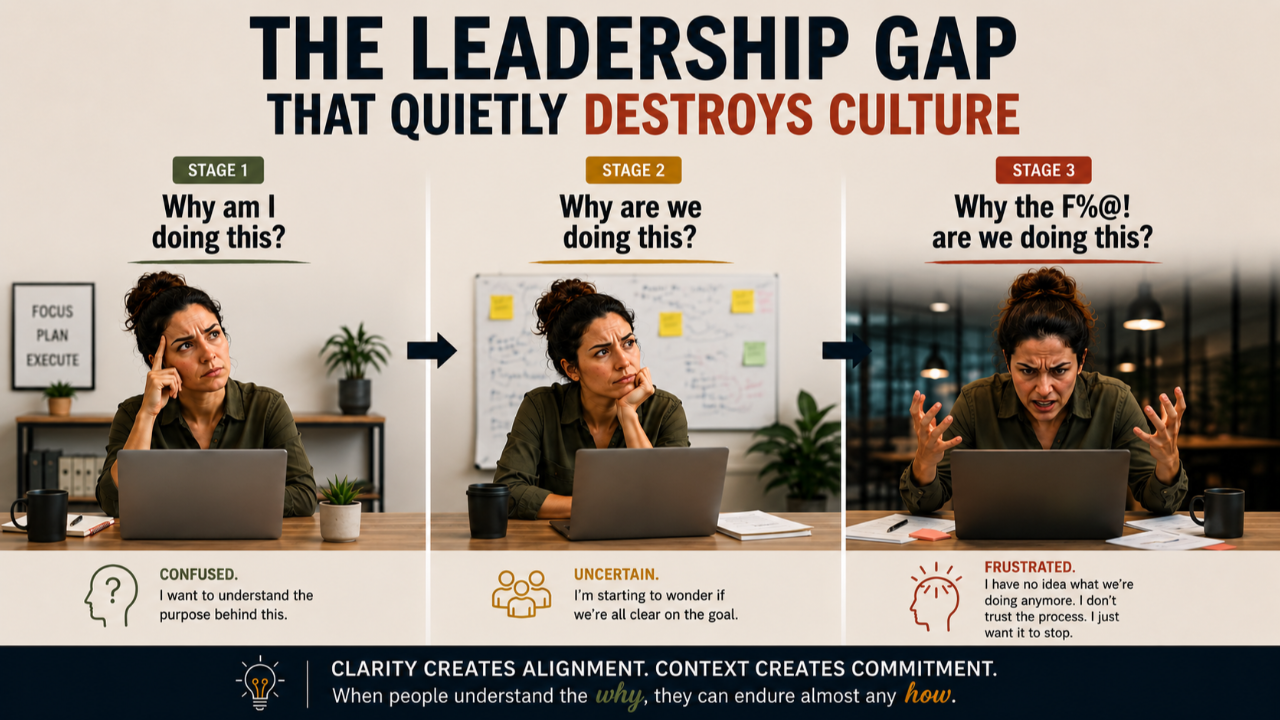
One of the biggest fractures inside organizations isn’t bad strategy.
It’s the absence of context.
Not secrecy. Not intentional withholding. Simply the gradual disconnect that happens when leadership stops explaining why decisions are being made.
A new initiative gets rolled out.
Processes change.
Priorities shift.
Teams restructure.
Targets evolve.
The leadership team understand the reasoning because (presumably) they were in the room where the conversation happened. And somewhere between the executive table and the front line, the meaning disappears.
People are told what to do without understanding why they’re doing it.
At first, most employees will still move forward. Good people usually do. They trust leadership. They assume there’s a larger strategy at play. They adapt because that’s what professionals do.
And eventually, questions can surface.
“Why are we changing this?”
“Why does this matter?”
“Why are we doing it this way?”
And if no one can answer those questions clearly, ...
Before You Chase What’s Next, Fix What’s Now

There’s something undeniably compelling about the future of a business—the vision, the scale, the possibilities. It pulls you forward. It sharpens your ambition. It gives meaning to the long hours and tough decisions.
And here’s the tension leaders don’t talk about enough:
When you become too attached to the future, you risk neglecting the very thing that determines whether you’ll ever get there—the present.
The quote says it plainly: “Don’t fall in love with the future until you get the present taken care of.”
It’s not a rejection of vision. It’s a recalibration of focus.
Because the future isn’t built in some distant, abstract space. It’s built in the conversations you’re having today. The decisions your team is making this week. The standards you’re either reinforcing, or quietly tolerating, right now.
And this is where your team becomes everything.
The Present Is a Team Sport
No founder or leader scales anything meaningful alone. Yet, many still operate as if execution is ...