How to Disagree Without Disconnecting

There’s a certain kind of conversation most of us have learned to brace for.
You see the message come in. Or you’re sitting across the table (hello Thanksgiving), and the topic takes a turn you didn’t ask for—and yet somehow expected. You can almost script the next five minutes in your head.
And if you’re honest, you’re not preparing to understand. You’re preparing to respond.
I read a piece recently about how cult experts approach conversations with people who hold deeply entrenched beliefs—especially political ones. What stood out wasn’t anything flashy or tactical. It was simple. Almost disarming.
They don’t start by trying to change the person’s mind. They start by protecting the relationship.
That idea lingers. Because if we’re honest, most of us do the opposite. We walk into disagreement trying to win clarity, prove a point, or correct what feels obviously wrong. And somewhere along the way, the connection thins out—or disappears entirely.
So, I’ve been thinking about what ...
Spring Forward… Again: What Daylight Saving Time Can Teach Us About Communication
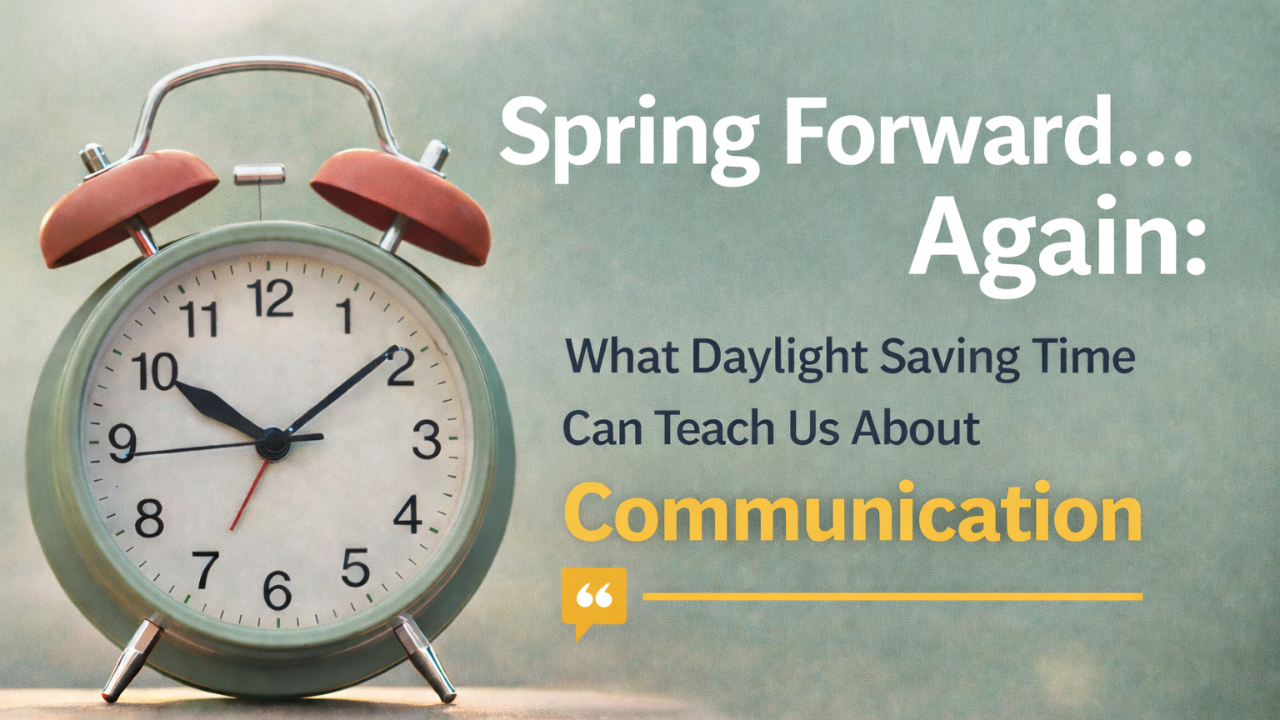
UGH. It’s Daylight Saving Time again.
The clocks jump forward. We lose an hour of sleep. Monday morning arrives faster than anyone asked for. And many of us find ourselves asking the same question we ask every single year:
Why are we still doing this? WHHHHHYYYYYYY?
Whether you love it or not, the reality is simple—every March we adjust the clock and move forward by one hour. It’s a small technical change, yet the ripple effects are immediate. Our routines feel off. Our energy dips. It takes a few days to regain our rhythm.
Interestingly enough, this annual reset offers a parallel to communication.
Communication isn’t static. Context changes. Priorities shift. People come and go. And when we continue communicating the same way we always have, things start to drift out of alignment. Messages get missed. Conversations stall. Teams operate on slightly different “clocks.”
Daylight Saving Time reminds us of something simple and powerful: sometimes a small adjustment creates a mean...
Presence Changes the Conversation—Long Before You Speak

Why intention, attention, and professionalism quietly shape credibility over time
Presence isn’t about being the most polished voice in the room. It’s about being fully there—grounded, intentional, and aware of the impact you’re creating in every interaction.
In a world that rewards speed and constant output, presence has become a quiet advantage. People can sense the difference between someone who’s responding out of habit and someone who’s showing up with purpose. The words may be similar. The experience is not.
What Presence Really Means
Presence in communication lives at the intersection of intention and attention.
- Intention is clarity around why you’re communicating. What matters in this moment? What needs to be understood, decided, or felt?
- Attention is where your focus lives while the exchange is happening. Are you listening to reply—or listening to understand? Are you present, or simply waiting for your turn?
When intention and attention align, communication becomes ...
Are Your Conversations Aging Faster Than You Think?

I recently shared an article in our “All The Things” email that explored a surprising idea: our brains can age at a pace that doesn’t always match the rest of us. What stood out wasn’t simply the science—it was the reminder that our cognitive patterns quietly influence how we show up every day. The researchers noted that these subtle shifts in brain-health can shape decision-making, emotional regulation, and even the way we interpret the world around us.
That insight stayed with me. Because if our internal processing changes the way we think, it naturally changes the way we communicate. The gaps, assumptions, or misunderstandings we experience in conversations often start long before words are spoken.
So, using that article as a launch point, with this blog I will take you into a more practical space—how communication actually works in our daily interactions, and a few intentional ways we can strengthen it.
When we communicate well, we shorten the distance between intention and unde...