
Ideas, Fruit Flies and a Glass of Wine

It’s fruit fly season over here.
You know the ones.
They hover around the kitchen. They appear out of nowhere. They buzz past your face when you’re trying to concentrate.
And then, after a long day, you finally pour yourself a well-deserved glass of wine, sit down, take that first sip and think, Ahhh…
Only to discover one of those little buggers has decided your wine looks pretty good too.
Seriously?
You wave them away. They come back.
You move the glass. They find it.
You think you’ve dealt with one and somehow three more appear.
Persistent little things.
And as I was rescuing my wine from one the other day, I started thinking…
Entrepreneurs know a little something about having persistent things buzzing around their heads too.
Except sometimes, it isn’t a fruit fly.
It’s an idea.
The Ideas We Carry Around
Entrepreneurs tend to have a lot going on upstairs.
An idea for a new service.
A change you know the business needs to make.
Something that isn’t quite working ...
The Dog Days Before the September Rush

There’s something distinct about these final days of August.
The pace is a little slower. Calendars still have gaps. Vacation messages are still popping up in our inboxes. Some people are squeezing in one last trip to the cottage, an afternoon on the patio, or a few extra hours outside before summer begins to slip away.
We’re in what people often call the “dog days of summer.”
The expression actually comes from Sirius—the “Dog Star”—and its connection to the hottest days of summer. Today, we tend to use it to describe those long, hot, sometimes sluggish days when everything seems to move just a little more slowly.
And maybe that’s exactly what we need before September arrives.
Because September has a very different energy.
Why Does September Feel Like a New Year?
We’ve written about this before, and there’s something about September that feels like a second New Year.
Perhaps it’s years of conditioning from back-to-school season. New notebooks. New schedules. New routines. A...
The Leadership Gap That Quietly Destroys Culture
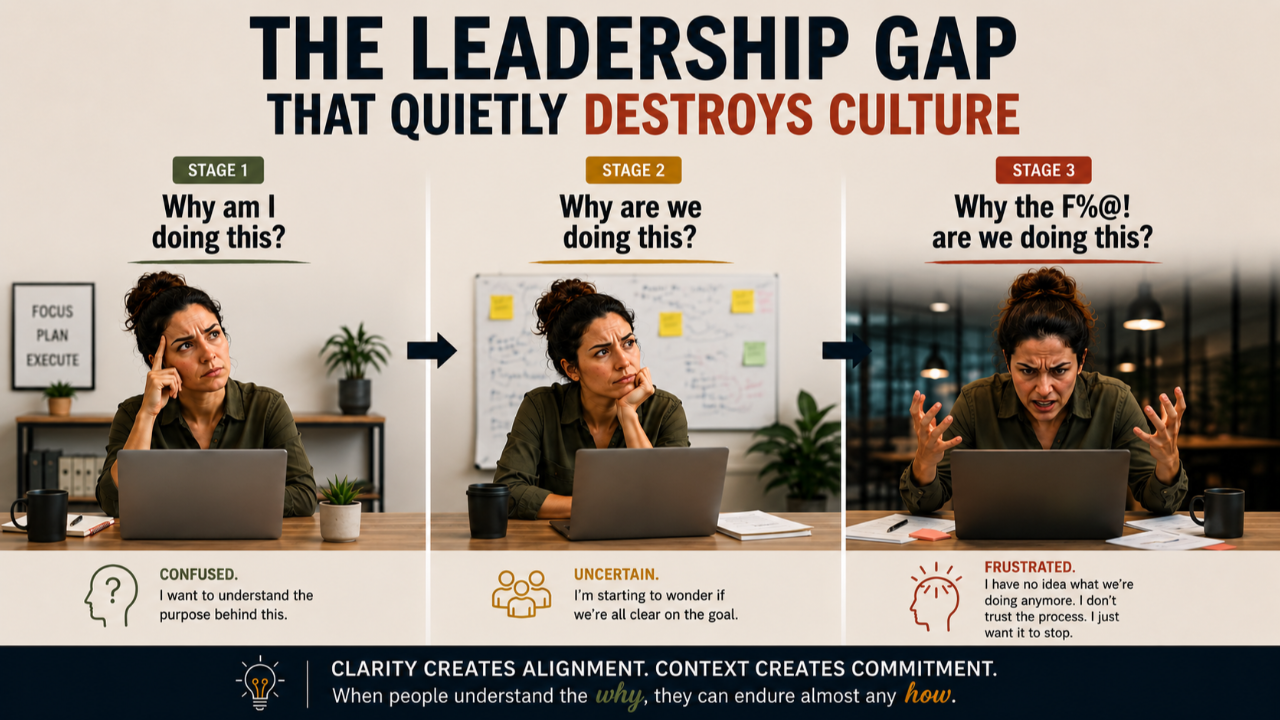
One of the biggest fractures inside organizations isn’t bad strategy.
It’s the absence of context.
Not secrecy. Not intentional withholding. Simply the gradual disconnect that happens when leadership stops explaining why decisions are being made.
A new initiative gets rolled out.
Processes change.
Priorities shift.
Teams restructure.
Targets evolve.
The leadership team understand the reasoning because (presumably) they were in the room where the conversation happened. And somewhere between the executive table and the front line, the meaning disappears.
People are told what to do without understanding why they’re doing it.
At first, most employees will still move forward. Good people usually do. They trust leadership. They assume there’s a larger strategy at play. They adapt because that’s what professionals do.
And eventually, questions can surface.
“Why are we changing this?”
“Why does this matter?”
“Why are we doing it this way?”
And if no one can answer those questions clearly, ...
Before You Chase What’s Next, Fix What’s Now

There’s something undeniably compelling about the future of a business—the vision, the scale, the possibilities. It pulls you forward. It sharpens your ambition. It gives meaning to the long hours and tough decisions.
And here’s the tension leaders don’t talk about enough:
When you become too attached to the future, you risk neglecting the very thing that determines whether you’ll ever get there—the present.
The quote says it plainly: “Don’t fall in love with the future until you get the present taken care of.”
It’s not a rejection of vision. It’s a recalibration of focus.
Because the future isn’t built in some distant, abstract space. It’s built in the conversations you’re having today. The decisions your team is making this week. The standards you’re either reinforcing, or quietly tolerating, right now.
And this is where your team becomes everything.
The Present Is a Team Sport
No founder or leader scales anything meaningful alone. Yet, many still operate as if execution is ...
The Trap That Keeps Business Owners Stuck in Execution

You don’t need better time management— clearer communication is the answer
If your calendar is full and your thinking feels compressed, it’s easy to assume the issue is time management. And you know what they say about assuming, right?
What you’re experiencing is the downstream effect of how your business communicates—how priorities are set, how decisions are made, and how clearly ownership is defined. When those elements lack clarity, everything flows back to you, and your capacity to think ahead disappears.
Many business owners reach a point where the days are productive, the team is moving, and yet something feels off. Decisions are happening quickly, and not always deliberately. Opportunities appear, and there’s little space to evaluate them properly.
This is what operating without foresight looks like. And more often than not, it comes down to one thing: a lack of protected thinking time—not a lack of ability.
When your time is consumed by the “urgent”, your ability to antici...
Spring Forward… Again: What Daylight Saving Time Can Teach Us About Communication
UGH. It’s Daylight Saving Time again.
The clocks jump forward. We lose an hour of sleep. Monday morning arrives faster than anyone asked for. And many of us find ourselves asking the same question we ask every single year:
Why are we still doing this? WHHHHHYYYYYYY?
Whether you love it or not, the reality is simple—every March we adjust the clock and move forward by one hour. It’s a small technical change, yet the ripple effects are immediate. Our routines feel off. Our energy dips. It takes a few days to regain our rhythm.
Interestingly enough, this annual reset offers a parallel to communication.
Communication isn’t static. Context changes. Priorities shift. People come and go. And when we continue communicating the same way we always have, things start to drift out of alignment. Messages get missed. Conversations stall. Teams operate on slightly different “clocks.”
Daylight Saving Time reminds us of something simple and powerful: sometimes a small adjustment creates a mean...
Milan 2026 Gave Us a Masterclass in Communication

We watched the world come together for the Olympic Games in Milan in 2026. Different languages. Different cultures. Different expectations. One global stage.
Yes, there were medals. Records were broken. History was made.
And what stayed with me wasn’t simply athletic performance (although that was fun to watch). It was the communication behind it — the subtle, powerful, often invisible forces that made the entire experience cohesive rather than chaotic.
If you were paying attention, Milan 2026 offered a masterclass. Not in sport. In communication.
Here’s the takeaway:
1. Clarity Wins in High-Pressure Moments
The Olympics are built on pressure. Milli-seconds matter. Decisions are scrutinized. Emotions run high.
In environments like that, vague messaging doesn’t survive.
Athletes rely on simple cues. Coaches give direct instructions. Commentators distill complex performances into clear narratives that anyone can understand. Even ceremonies carry focused themes rather than clut...
What Poor Communication Really Costs Your Business

And why it’s more than you think
It’s easy to spot a missed deadline or a dropped ball. What’s harder to see—and often more damaging—is the ripple effect of poor communication across your team or organization.
There is a tendency to refer to “communication issues” as soft problems. Interpersonal. Inevitable. Something to bring up in a 360 review or a quarterly training. And here’s the truth: poor communication isn’t simply a culture issue—it’s a business risk. One that quietly erodes productivity, trust, and profitability every single day it goes unaddressed.
Let’s uncover what it really costs.
1- Lost Time You’ll Never Get Back
Misaligned priorities. Endless email threads. Meetings that feel like déjà vu. When teams aren’t clear on expectations, timelines, or ownership, even high performers can spin their wheels.
And it’s not only frustrating—it’s expensive.
According to a McKinsey study, employees spend an average of 28% of their workweek on email and another 20% on internal ...