
The Leadership Gap That Quietly Destroys Culture
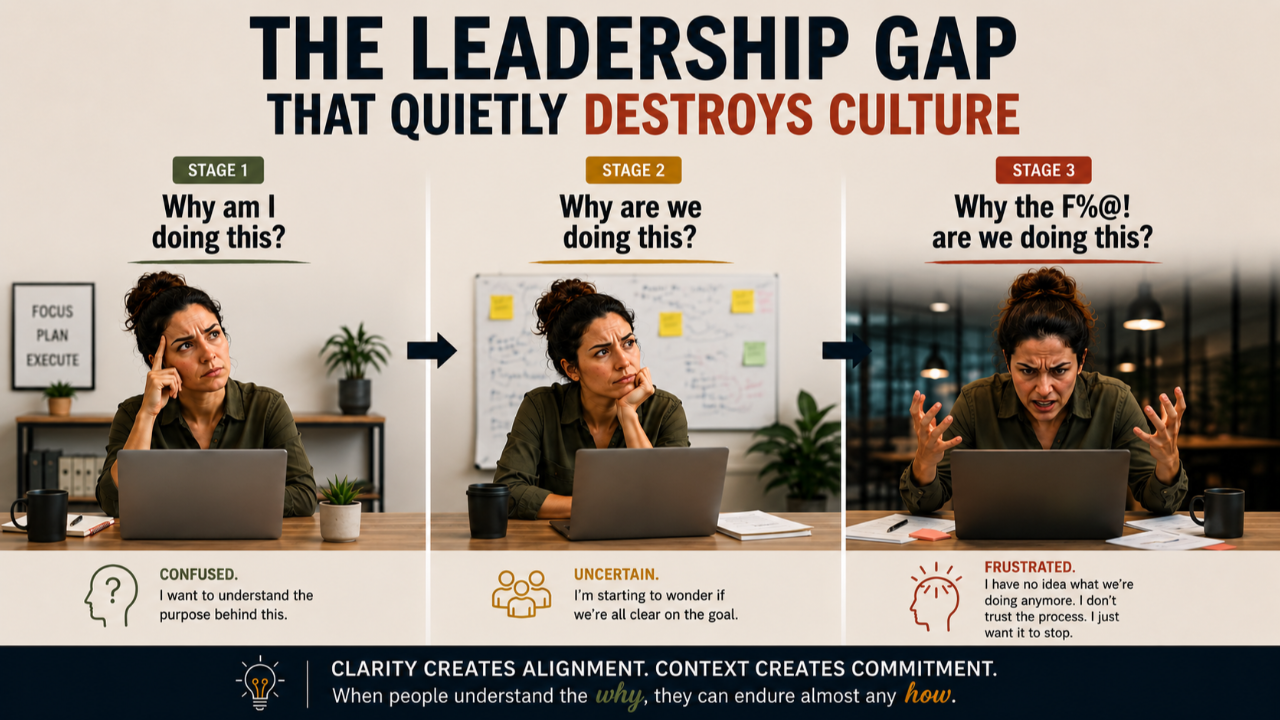
One of the biggest fractures inside organizations isn’t bad strategy.
It’s the absence of context.
Not secrecy. Not intentional withholding. Simply the gradual disconnect that happens when leadership stops explaining why decisions are being made.
A new initiative gets rolled out.
Processes change.
Priorities shift.
Teams restructure.
Targets evolve.
The leadership team understand the reasoning because (presumably) they were in the room where the conversation happened. And somewhere between the executive table and the front line, the meaning disappears.
People are told what to do without understanding why they’re doing it.
At first, most employees will still move forward. Good people usually do. They trust leadership. They assume there’s a larger strategy at play. They adapt because that’s what professionals do.
And eventually, questions can surface.
“Why are we changing this?”
“Why does this matter?”
“Why are we doing it this way?”
And if no one can answer those questions clearly, frustration starts replacing alignment.
Because most people can handle hard work.
They can handle pressure.
They can even handle uncertainty for a surprisingly long time.
What people struggle with is feeling disconnected from purpose.
When the why disappears, work starts to feel transactional. Teams stop seeing how their contribution fits into something larger. And when humans can’t find meaning, they start creating their own explanations — usually based on fear, assumptions, or distrust.
That’s where culture quietly starts to erode.
I’ve seen this happen inside organizations more times than I can count. The emotional progression is almost always the same:
“Why am I doing this?”
turns into
“Ugh, why am I doing this?”
and eventually becomes
“Arrrgh, why the f*%! am I doing this?”
That final question, ooof.
By the time people reach that point, they’re no longer asking for clarity. They’re expressing disconnection. The relationship between leadership and the team has started to fracture because people no longer understand the purpose behind the work.
And contrary to what many organizations assume, resistance to change usually isn’t about the change itself. Most people can adapt when they understand the reason behind the decision.
People support what they understand.
People commit to what they can connect to.
That’s why cascading information across an organization matters so deeply.
I know this will be a shock…I’m not a big fan of polished corporate speak or generic messaging that says a lot without saying anything. I’m suggesting real communication. Honest communication. The kind that gives people enough context to understand where the organization is going and how they fit into it.
The strongest leaders consistently answer four questions:
That level of clarity creates alignment instead of compliance.
There’s another layer to this that leaders often overlook.
If someone in leadership can’t articulate the why behind a decision, they also lose the ability to honour someone else’s why.
A disconnected manager will often dismiss employee concerns — they’re not malicious, it’s that they themselves were never given enough context to connect to the decision in the first place.
Disconnection cascades downward just as quickly as clarity does.
Leadership communication can’t stop at the executive level. Meaning and the “why” always traveling through every layer of the organization is critical. Managers need enough understanding and guidance to translate vision into relevance for their teams.
Otherwise, organizations end up with talented people executing tasks they no longer believe in.
Performance might survive for a while.
Processes might still function.
Deadlines might still get met.
And culture won’t.
And eventually, neither will retention, trust, or engagement.
A few practical ways leaders can strengthen alignment immediately:
Leadership is not only about directing people toward outcomes. It’s about helping people understand why the work matters in the first place. Because when people understand the why, they become more resilient, more engaged, and more connected to the mission.
And when they don’t, they eventually stop asking questions altogether.
That silence is usually the moment leaders pay attention, and it’s often too late.
If your organization is struggling with alignment, communication breakdowns, or leadership disconnect between teams and executives, this can be rebuilt. Strong cultures don’t happen accidentally — they’re created through clarity, trust, and consistent leadership communication. That’s the real work we love to help entrepreneurial organizations do. Email us today.